Two resorts, one carefully planned travel day
Private transportation between Vail and Aspen works best when the transfer has its own place in the itinerary. Provide the actual Vail pickup address and Aspen destination, passenger count and any fixed appointment after arrival. A resort name is not an entrance instruction, and reaching the edge of town is not the same as unloading at a residence. Confirm which side of each property the vehicle should use.
In good conditions, the Vail–Aspen drive is roughly two hours in winter via Glenwood Springs and I-70. Weather can add significant time. Treat the estimate as a starting point for planning, not a guaranteed arrival. Boarding, loading skis, breaks and the final approach to lodging add to the overall trip. Avoid scheduling a nonrefundable activity immediately after an optimistic map estimate.
The winter route does not use Independence Pass
Independence Pass on Highway 82 is closed roughly November through late May. Winter travel between Vail and Aspen uses the Glenwood Springs and I-70 corridor, not a direct trip over the pass. Do not rely on a navigation suggestion without checking seasonal restrictions and current road conditions. A closed mountain pass is not an optional shortcut that a private chauffeur can make available.
In summer, travel via Independence Pass can be shorter, but only when the road is open and the route is suitable for the selected vehicle and current conditions. Vehicle restrictions matter, particularly for longer vehicles; confirm those before making the pass part of the itinerary. Seasonal opening does not guarantee suitable conditions every day. Route selection should prioritize lawful, appropriate travel rather than a scenic-road request or a promised time saving.
Choose a departure with weather and commitments in mind
If the transfer follows a final ski morning in Vail, allow time to return equipment, change, pack and check out before pickup. The chauffeur should not be scheduled as though the party will walk straight from the lift into a fully packed vehicle. Tell us whether skis are traveling with you or being returned locally, and include any required stop in the estimate.
For an Aspen dinner or an onward flight, work backward from that commitment and leave a meaningful weather buffer. Current road restrictions or closures can make a planned arrival impractical; no vehicle booking guarantees that the corridor stays open. Keep one organizer responsible for timing updates, and discuss changes as soon as the travel plan shifts rather than waiting until every guest has gathered at the original departure time.
Ski bags, suitcases and the right cabin
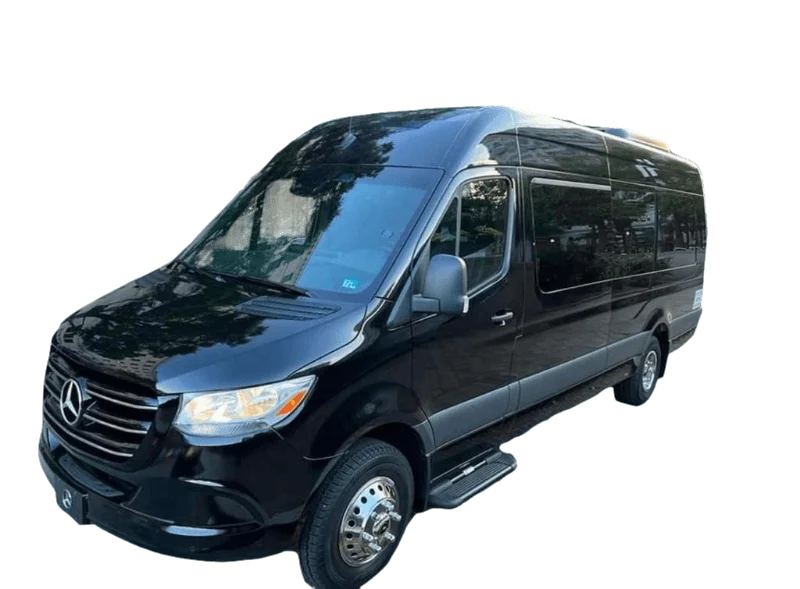
A resort-to-resort transfer usually carries more than a local ski shuttle. Count full suitcases, carry-ons, skis, boards, boot bags and any oversized items when requesting a vehicle. Black SUVs accommodate up to six passengers, while Executive Sprinters accommodate 9–13 depending on configuration. Actual luggage capacity must be confirmed for the chosen layout; do not book by seat count alone and hope the equipment can be squeezed in.
For larger groups, party buses accommodate 20–40 passengers, some up to roughly 50, and motor coaches accommodate 40–56. Those numbers describe passenger capacity, not a promise about your exact ski-luggage load. Explain whether the priority is luggage practicality, a social cabin or keeping several households together. Keep medication, travel documents and essential layers accessible, especially when a weather delay could make the journey longer than expected.
Stops, family needs and the return direction
Ask for planned comfort stops when arranging the transfer, particularly with children or a mixed-age group. Request child seats in advance and describe any boarding assistance needs. WiFi is available in every vehicle, but do not build a critical business commitment around uninterrupted mountain connectivity. A comfortable travel day depends on realistic expectations as much as the vehicle category.
For the return from Aspen to Vail, create a separate departure plan rather than copying the first journey without checking its assumptions. Checkout deadlines, equipment returns and afternoon road conditions may differ. If travelers are splitting between Vail lodging and another destination, provide every stop and passenger allocation. A transfer to Vail is not the same job as an Eagle County Airport connection, even if both involve travel in the same general region.
Connect the transfer to your Aspen ski week
If the Vail–Aspen journey starts a longer stay, request dedicated ski-week chauffeur service separately from the inter-resort transfer. Include morning drop-offs, après pickups, gear handling and dinner runs for each day you want reserved. That keeps the long travel day from being confused with open-ended local availability. Confirm the booked service windows and how a mountain change or late dinner affects the schedule.
Hourly planning ranges vary by vehicle size and season: black SUVs are $125–$200 per hour, Sprinter limo vans $200–$350, stretch limos $150–$350, and party buses and motor coaches $250–$400. These ranges are not a fixed Vail–Aspen transfer fare. Request the full proposal with the route, service time, stops and terms so you can compare complete plans rather than multiplying the shortest drive estimate by an hourly number.
We are open 24/7. Hablamos español. Every vehicle has WiFi, and vehicles have winter tires all ski season.
Text (970) 672-0787 for a FREE custom estimate and we'll text you back. You can also call (970) 818-2489 or email reservations@phatlimo.com. Include your dates, lodging address, passenger count, equipment count and intended stops so the proposal reflects the actual day rather than just the distance between two points.